
Before you throw a single punch at Witherspoon Boxing & Fitness in Bristol Borough, PA, there is one preparation step that every coach at this boxing gym in Bristol PA insists upon without exception — wrapping your hands correctly. Knowing how to wrap hands for boxing properly is not a minor procedural detail. It is the foundational safety practice that protects the 27 bones, 29 joints, and numerous ligaments and tendons of your hands and wrists from the cumulative impact forces of boxing training.
Led by former professional boxer Tim Witherspoon Jr., Witherspoon Boxing & Fitness treats hand wrapping as a first-session priority for every new member — because injuries to unwrapped or poorly wrapped hands set training back by weeks and are entirely preventable. Learn more about the gym’s safety-first coaching approach on the about us page. According to USA Boxing, hand wraps are mandatory equipment for all training and competition activities precisely because of the significant protective benefit they provide against the most common boxing training injuries.
Why Hand Wrapping Matters More Than Most Beginners Realize
Many beginners in boxing training for beginners programs at this boxing fitness center underestimate the importance of hand wrapping — assuming that gloves alone provide sufficient protection. They do not. Boxing gloves cushion the external impact on the knuckles but provide minimal support for the internal structures of the hand — the metacarpal bones, the carpals of the wrist, and the ligaments that hold all of these structures in correct alignment during impact.
Hand wraps compress and stabilize the entire hand structure — binding the wrist, supporting the metacarpals, and protecting the knuckles from internal shear forces that occur even through well-padded gloves. Without wraps, the repetitive impact of bag work and combination drilling progressively stresses these structures in ways that produce chronic soreness, ligament strain, and eventually stress fractures in members who train regularly over weeks and months. Learning how to wrap hands for boxing correctly from the first session prevents all of these outcomes. Check session schedules on the schedule page.
What You Need — Choosing the Right Hand Wraps
Before learning how to wrap hands for boxing, selecting the right wraps is important. Coaches at Witherspoon Boxing recommend the following specifications for new members across all boxing classes in Bucks County.
- Length: 180-inch wraps for adults with average to large hands. 120-inch wraps for youth members and adults with smaller hands. Longer wraps provide more coverage and support — when in doubt, choose the longer option.
- Material: Cotton or cotton-elastane blend for training wraps. The slight stretch of elastane blends allows a more anatomically conforming wrap that moves with the hand during combination work. Avoid purely synthetic fabrics that do not breathe adequately during intense sessions.
- Closure: Hook-and-loop (Velcro) closure at the wrist for easy application and adjustment. Avoid traditional tie closures for training — they loosen during sessions and require assistance to apply tightly enough to be protective.
- Color: Entirely your preference — but having two pairs allows one to be washed while the other is available for the next session. Wraps accumulate significant sweat during training and require washing after every two to three uses.
The coaches at this boxing gym in Bristol PA can advise on specific wrap brands and sizing on your first visit. Explore the gym environment through the gallery.

How to Wrap Hands for Boxing — The Complete Step-by-Step Method
The following is the standard hand wrapping method taught to every new member beginning boxing training for beginners at Witherspoon Boxing & Fitness. Practice this sequence before your first session so that wrapping becomes quick and automatic before you arrive at the gym.
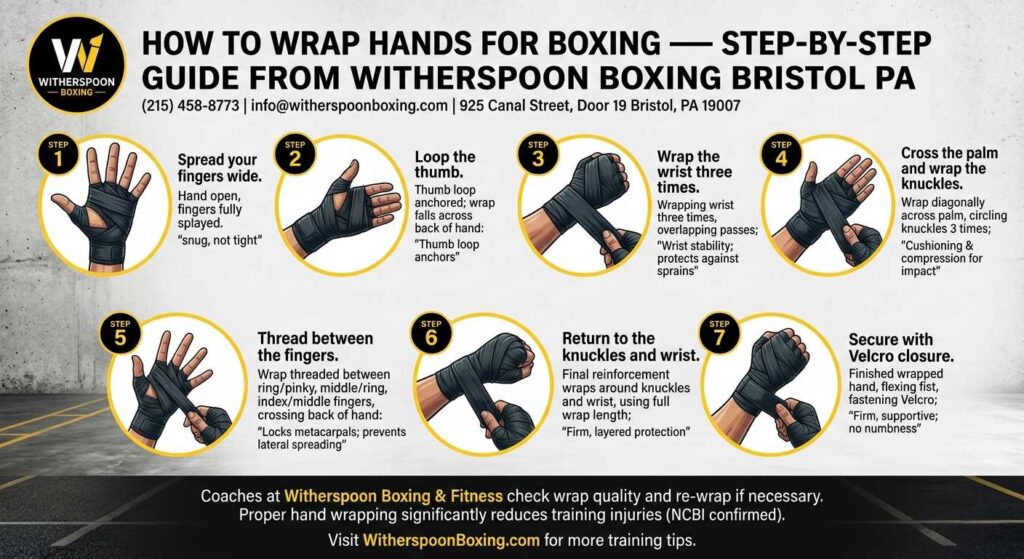
Step 1 — Spread your fingers wide. Hold your hand open with fingers spread as far apart as possible throughout the wrapping process. This ensures the wrap is applied at the correct tension — snug enough to be protective without being tight enough to restrict circulation or limit movement when the fist is closed.
Step 2 — Loop the thumb. Place the loop at the end of the wrap over your thumb and allow the wrap to fall across the back of your hand toward the wrist. The thumb loop anchors the wrap in correct position throughout the application.
Step 3 — Wrap the wrist three times. Circle the wrap around the wrist three times, working from the thumb side across the back of the hand and around the wrist each time. Each pass should overlap the previous by approximately half its width. The wrist wrap is the most structurally important component of the application — providing the lateral stability that protects against wrist sprains under impact.
Step 4 — Cross the palm and wrap the knuckles. Bring the wrap across the palm diagonally to the base of the knuckles and circle the knuckles three times. The knuckle wrap should cover all four knuckles completely with each pass, providing the cushioning and compression that reduces knuckle impact forces during bag work.
Step 5 — Thread between the fingers. From the knuckle wrap, bring the wrap up between your pinky and ring finger, across the back of the hand to the wrist, and back up between the ring and middle finger. Repeat this process between each finger pair — ring and middle, middle and index — threading the wrap across the back of the hand between each pass. This inter-finger threading locks the metacarpal bones into their correct alignment and prevents the lateral spreading under impact that causes the most common boxing hand injuries.
Step 6 — Return to the knuckles and wrist. After threading between all finger pairs, wrap across the knuckles one to two additional times to reinforce the earlier knuckle protection, then circle the wrist two to three more times using any remaining wrap length. The goal is to use the full length of the wrap in building a firm, layered protection structure across the entire hand.
Step 7 — Secure with the Velcro closure. Fasten the hook-and-loop closure firmly around the wrist. The finished wrap should feel firm and supportive with no pressure points or areas of numbness. Close your fist completely — the wrap should feel snug but not restricting. Open and close your fist three to four times to confirm comfortable range of motion before putting on your gloves.
Coaches at Witherspoon Boxing & Fitness check wrap quality at the beginning of sessions and will re-wrap any member whose wraps are applied incorrectly or insufficiently. Proper hand wrapping is taken seriously at this boxing fitness center because the injuries it prevents are real, common, and entirely avoidable. The National Center for Biotechnology Information confirms that wrist and metacarpal injuries are among the most common training injuries in boxing — and that proper hand wrapping significantly reduces their incidence. Follow training safety tips on the blog.
Common Hand Wrapping Mistakes to Avoid
Even after learning how to wrap hands for boxing correctly, beginners commonly make the following errors in early practice. Coaches at this boxing gym in Bristol PA watch for and correct all of these in every beginner session.
- Wrapping with fingers closed: Always wrap with fingers spread — wrapping with a closed fist produces a wrap that is too tight when the fist opens and too loose when it closes, providing neither comfort nor adequate protection
- Insufficient wrist passes: The wrist requires a minimum of three wrap passes to provide adequate lateral stability — fewer than this leaves the wrist vulnerable to the most common boxing training injury
- Skipping inter-finger threading: This step is the most commonly omitted and the most important for metacarpal protection — never skip it regardless of time pressure before a session
- Wrapping too loosely: A wrap that slides during training provides no structural support — the wrap should feel firmly applied immediately after finishing, before any slippage can occur
- Not washing wraps regularly: Unwashed wraps accumulate bacteria and cause skin irritation — wash after every two to three uses and allow to air dry completely before the next session
Questions about hand wrapping or equipment for your first session at this boxing gym in Bristol PA? Contact the team through the contact page. Stay current with training tips and gym news through the news page.
Start Training Safely at Witherspoon Boxing Today
Knowing how to wrap hands for boxing correctly is the first step in a safe and productive boxing journey at Witherspoon Boxing & Fitness in Bristol Borough, PA. Led by Tim Witherspoon Jr. and a coaching team that prioritizes member safety as the foundation of every program, this boxing fitness center ensures that every member — from beginners just starting boxing classes in Bucks County to experienced athletes in advanced training — is always properly protected and always properly coached. Youth boxing classes members receive the same hand wrapping instruction and supervision as adult members, with age-appropriate wrap sizing and coach-assisted application for younger athletes.
Click → Apply Now and start your safe, expert-coached boxing journey at Bristol PA’s best boxing gym today.