
In boxing, the difference between a punch landing and a punch missing is often measured in milliseconds — and the physical quality that determines those milliseconds is reaction time. Boxing reaction time drills at Witherspoon Boxing & Fitness in Bristol Borough, PA develop the neural speed, anticipatory awareness, and reflexive movement quality that transform technically capable boxers into genuinely unpredictable, defensively sophisticated athletes. Under the coaching of former professional boxer Tim Witherspoon Jr., boxing reaction time drills are built into programming at every experience level — from boxing training for beginners discovering their first defensive movements through competitive athletes preparing for their next fight.
Learn about the coaching depth at the gym on the about us page. The National Center for Biotechnology Information confirms that reaction time is highly trainable through specific drills — with dedicated reactive training producing measurable improvements in visual-motor processing speed, anticipatory movement initiation, and decision-making speed in athletes across all experience levels and age groups.

What Reaction Time Actually Means in Boxing
Before discussing specific boxing reaction time drills, understanding what reaction time means in the context of actual boxing performance clarifies which qualities the training at Witherspoon Boxing is developing and why those qualities matter for boxing effectiveness. Boxing reaction time is not simply the speed of a reflexive response to a clear stimulus — it is the integration of visual processing, pattern recognition, movement prediction, decision selection, and motor program execution that happens in fractions of a second when a training partner or opponent initiates an attack or creates a defensive opening.
Elite boxing reaction time involves not just responding to what has already happened but anticipating what is about to happen — reading the subtle pre-movement cues in an opponent’s stance, weight distribution, and shoulder position that predict which punch is coming before it is thrown. This anticipatory component — developing through exposure to movement patterns and the specific pre-movement cues that telegraph them — is what coaches at this boxing gym in Bristol PA develop alongside pure reflex speed in every reaction training session. Check class structures on the schedule page.
Reaction Time Drill 1 — The Double-End Bag
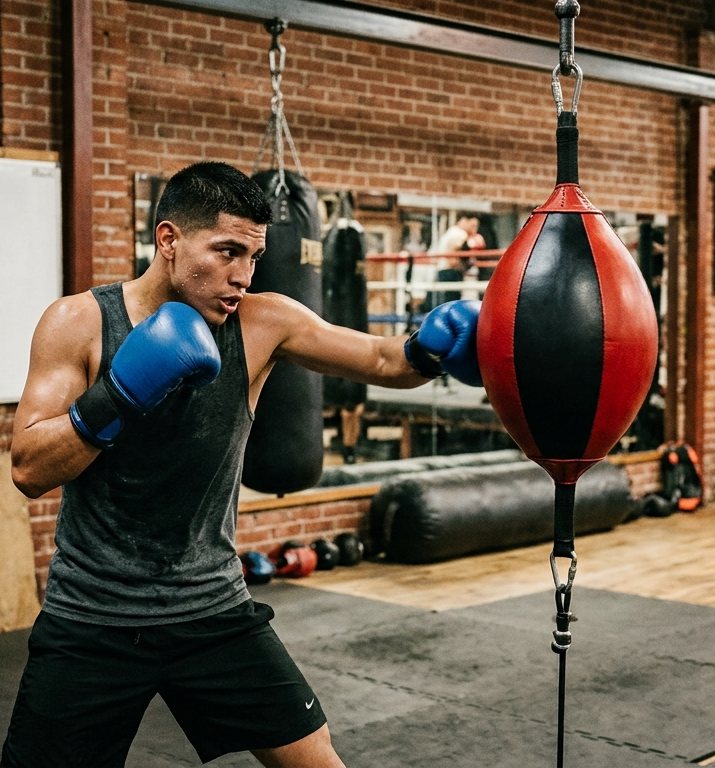
The double-end bag is the most boxing-specific tool for developing boxing reaction time drills — because its elastic cord attachment causes it to rebound along irregular, partially unpredictable paths after each strike, requiring the practitioner to track its movement, time their response, and execute follow-up punches reactively rather than in predetermined rhythmic patterns. This unpredictability is exactly what makes the double-end bag so effective for reaction development — each session provides thousands of reactive timing challenges that develop the visual-motor processing speed and punch timing precision that actual boxing demands.
Coaches at Witherspoon Boxing introduce the double-end bag progressively — beginning with a loosely adjusted elastic that slows the rebound and allows beginners to track the bag’s movement at manageable speed before progressively tightening the cord adjustment to produce faster, more unpredictable rebounding that demands genuinely rapid reactive response. Members who train double-end bag work consistently for six to eight weeks at this boxing fitness center report measurable improvements in their punch timing, combination connection rate, and defensive response speed against moving targets. Explore reaction training in action through the gallery.
Reaction Time Drill 2 — Coach-Called Combination Responses
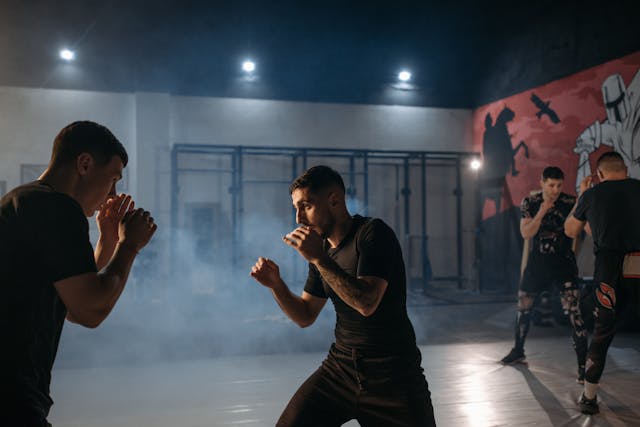
Coach-called combination responses are among the most effective boxing reaction time drills for developing the audio-motor reaction speed and combination selection decision-making that boxing competition demands. A coach stands in front of the practitioner calling out combination numbers or punch names at varying intervals and speeds — the boxer executes the called combination immediately with correct mechanics and returns to guard before the next call.
The reaction demand of this drill — responding to an unexpected audio cue with a specific physical sequence while maintaining technical quality — develops the neural pathways connecting stimulus recognition to motor program selection and execution that determine boxing reaction performance.
As the vocabulary of called combinations grows and the intervals between calls become less predictable, the cognitive and reactive demand of the drill escalates — continuously challenging the practitioner’s response speed and combination selection accuracy in ways that maintain training adaptation rather than allowing full adjustment to a fixed demand level. Tim Witherspoon Jr. and his coaching team design call-and-respond sessions with the same expertise they bring to every technical development program at this boxing and fitness center. Follow reaction training insights on the blog.
Reaction Time Drill 3 — Reflex Ball Training
The reflex ball — a small rubber ball attached to an elastic cord worn on the head — is one of the most effective and most portable tools for developing the hand-eye reaction speed component of boxing reaction time drills. The practitioner strikes the ball, which rebounds unpredictably based on the angle and force of each strike, and must track and strike it again with alternating hands at maximum speed. The unpredictability of the ball’s rebound path and speed creates a continuous high-frequency reactive demand that develops hand-eye coordination and visual-motor processing speed at a rate that bag work alone cannot match.
Reflex ball training at Witherspoon Boxing is incorporated into warm-up sequences and as a supplementary speed development tool for members pursuing hand speed and reaction time development as primary training priorities. The American Council on Exercise identifies reflex ball training as one of the most time-efficient tools for developing the visual-motor coordination components of athletic performance in boxing and racket sports. Stay connected through the news page. Questions about reaction training? Contact the team through the contact page.

Sharpen Your Reflexes at Witherspoon Boxing Today
Boxing reaction time drills at Witherspoon Boxing & Fitness in Bristol Borough, PA under the expert coaching of Tim Witherspoon Jr. and his team develop the genuine neural speed, anticipatory awareness, and reflexive movement quality that separate good boxers from great ones. Whether you are pursuing boxing training for beginners for the first time or competitive development at an advanced level, the reaction training at this boxing gym in Bristol PA accelerates every dimension of your boxing performance. Visit the schedule page.
Click → Apply Now and start sharpening your boxing reflexes at Witherspoon Boxing Bristol PA today.