By Tim Witherspoon Jr.
7 min read
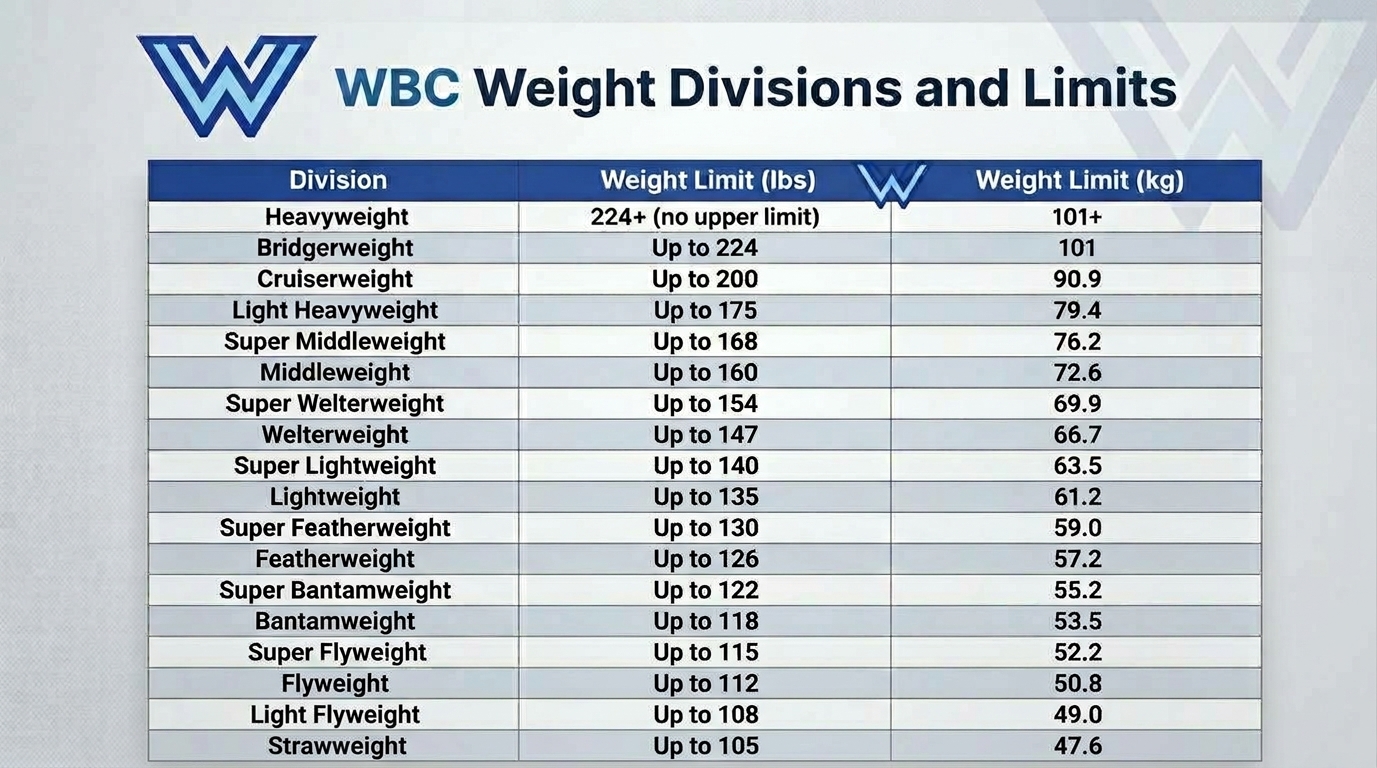
Boxing weight classes explained simply: professional boxing uses 18 divisions running from Strawweight at 105 pounds up to Heavyweight, which has no upper limit. Each division has a maximum weight a boxer must make at the official weigh-in. Amateur boxing uses fewer divisions with different limits, set by the governing body rather than by professional sanctioning organisations.
Our coaches at Witherspoon Boxing + Fitness — the boxing gym Bristol PA has trusted for two generations — get asked this by members curious about where they would fall. Here is the full reference.
Professional Boxing Weight Classes
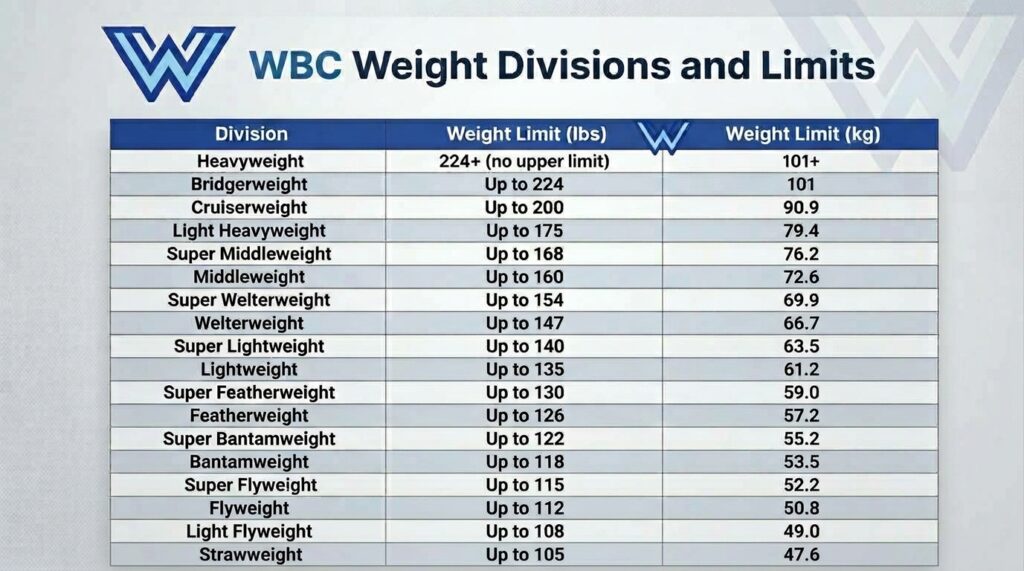
These are the official limits published by the World Boxing Council. Names vary slightly between sanctioning bodies, but the cutoff weights are standardised across them.
| Division | Weight Limit (lbs) | Weight Limit (kg) |
|---|
| Heavyweight | 224+ (no upper limit) | 101+ |
| Bridgerweight | Up to 224 | 101 |
| Cruiserweight | Up to 200 | 90.9 |
| Light Heavyweight | Up to 175 | 79.4 |
| Super Middleweight | Up to 168 | 76.2 |
| Middleweight | Up to 160 | 72.6 |
| Super Welterweight | Up to 154 | 69.9 |
| Welterweight | Up to 147 | 66.7 |
| Super Lightweight | Up to 140 | 63.5 |
| Lightweight | Up to 135 | 61.2 |
| Super Featherweight | Up to 130 | 59.0 |
| Featherweight | Up to 126 | 57.2 |
| Super Bantamweight | Up to 122 | 55.2 |
| Bantamweight | Up to 118 | 53.5 |
| Super Flyweight | Up to 115 | 52.2 |
| Flyweight | Up to 112 | 50.8 |
| Light Flyweight | Up to 108 | 49.0 |
| Strawweight | Up to 105 | 47.6 |
Full limits are published by the World Boxing Council.
Why the Names Are Confusing
The same division often carries two or three names depending on which organisation you are reading. The weights are identical — only the labels differ.
| Weight | Also Called |
|---|
| 154 lbs | Super Welterweight · Junior Middleweight · Light Middleweight |
| 140 lbs | Super Lightweight · Junior Welterweight · Light Welterweight |
| 130 lbs | Super Featherweight · Junior Lightweight |
| 122 lbs | Super Bantamweight · Junior Featherweight |
| 115 lbs | Super Flyweight · Junior Bantamweight |
| 105 lbs | Strawweight · Minimumweight · Mini Flyweight |
As a rule: “super” and “junior” divisions sit between the eight traditional classes. If a division name contains either word, it is one of the later additions.
The Original Eight
Boxing began with eight divisions, still referred to as the traditional or glamour classes:
- Heavyweight
- Light Heavyweight
- Middleweight
- Welterweight
- Lightweight
- Featherweight
- Bantamweight
- Flyweight
Everything else was added later as the sport grew and sports medicine made the case for narrower gaps between divisions.

Amateur Weight Classes
Amateur divisions differ from professional ones in two important ways. There are fewer of them, and amateur boxers must also meet a minimum weight for their division — professionals only need to come in under the maximum.
Amateur categories have also been changing. USA Boxing updated the divisions contested at its Elite and Youth National Championships ahead of international governing body changes, and further adjustments are expected as Olympic divisions are confirmed for future Games.
For that reason, anyone considering competing should check current divisions directly with USA Boxing rather than relying on any third-party list, including this one. Our coaches will walk you through registration, medicals, and which division suits you when the time comes.
Other Amateur Age Divisions
Amateur boxing is also split by age, not just weight:
- Bantam, Intermediate and Junior divisions for younger age groups
- Youth / U19
- Elite — the open adult category
- Masters — generally for boxers aged 41 and above, with separate rules and shorter rounds
Masters boxing is worth knowing about for anyone who assumes competition is only for people in their twenties. It is a real and well-established category.
How Weigh-Ins Work
- Professional bouts typically weigh in the day before the fight, allowing time to rehydrate and eat afterward.
- Amateur bouts usually weigh in on the morning of competition, which leaves far less room for weight manipulation.
- Missing weight can mean forfeiting a purse, losing title eligibility, or being pulled from the card entirely.
- Catchweight bouts are agreed at a weight between two divisions when fighters from different classes meet.
That difference in weigh-in timing is the main reason amateur boxers generally compete much closer to their natural weight.

An Honest Word on Cutting Weight
You will see a lot written about dropping weight before a weigh-in. We are not going to cover methods here, and we would not advise anyone training for fitness to think about it at all.
Aggressive weight manipulation carries real health risks, and it belongs only in the context of a competitive athlete working under direct supervision from a coach, a doctor, and ideally a registered dietitian. If you are considering competing, that conversation starts with your doctor — not an article, and not a forum.
For everyone else, which is the overwhelming majority of people who train: your weight class is not relevant. Train for fitness, skill, and enjoyment, and let your body settle where it settles.
Where Would You Fall?
Purely out of interest, here is roughly where common adult body weights sit in the professional system:
| Your Weight | Nearest Pro Division |
|---|
| 130 lbs | Super Featherweight |
| 145 lbs | Welterweight |
| 155 lbs | Middleweight |
| 170 lbs | Light Heavyweight |
| 190 lbs | Cruiserweight |
| 210 lbs | Bridgerweight |
| 230 lbs | Heavyweight |
Worth repeating: this is trivia unless you plan to compete. Nobody in a Tuesday evening class is boxing in a division.
Training in Bucks County
Boxing Weight Classes Explained – Most of our members train for fitness, stress relief, and the skill itself, with no interest in competing. Our boxing training for beginners program assumes zero experience, and gloves are provided for your first sessions.
The boxing classes Bucks County members rely on run seven days a week:
- Beginner Boxing — Mon/Wed 9:00 AM & 5:00 PM, Fri 9:00 AM, Sat 9:00 AM
- Advanced Boxing — Mon/Wed 6:00 PM, Sat 9:00 AM
- Adult Boxing — Tue/Thu 12:00 PM
- Women’s Boxing — Tue/Thu 7:00 PM, Sat 11:00 AM
- Kids Boxing (Ages 6–12) — Mon/Wed 7:00 PM, Tue/Thu 6:00 PM
- Cardio Boxing — Mon/Wed/Fri 6:00 AM, Tue/Thu 9:00 AM & 5:00 PM
- Sparring Lab — Mon/Wed 7:00 PM, Sat 10:00 AM
- Recovery & Mobility — Sun 9:00 AM
For members who do want to compete, we handle the full pathway — technique, supervised sparring, conditioning, and the registration and medical process through USA Boxing. See the full weekly schedule.
Our staff is led by Tim Witherspoon Jr., and the Witherspoon family has competed at the professional level since the 1970s — so questions about divisions, matchmaking, and what competing actually involves get answered by people who have lived it. Read more on our about us page or see the gym in our gallery.
Anyone searching learn boxing near me in lower Bucks County will find a genuine boxing fitness center here, and our youth boxing classes for ages 6 to 12 are entirely non-contact. For most members, boxing and fitness is the whole point and competition never enters the picture.
Frequently Asked Questions
How many weight classes are there in boxing?
The World Boxing Council recognises 18 professional divisions, from Strawweight at 105 pounds to Heavyweight, which has no upper limit.
What is the heaviest weight class in boxing?
Heavyweight, with a minimum of 224 pounds and no maximum.
What is Bridgerweight?
A division between Cruiserweight and Heavyweight, with an upper limit of 224 pounds.
Why do divisions have multiple names?
Different sanctioning bodies use different labels for the same weight. The limits are standardised even where the names are not.
How do amateur weight classes differ?
Amateur boxing uses fewer divisions, requires boxers to meet a minimum as well as a maximum weight, and weighs in on the day of competition.
Can a boxer change weight class?
Yes. Boxers frequently move divisions across a career, and winning titles in multiple classes is considered a major achievement.
Do I need to worry about weight class if I train for fitness?
No. Weight divisions only matter for sanctioned competition.
What is a catchweight?
An agreed weight between two divisions, used when fighters from different classes meet.
Come Train — No Division Required
Weight classes are interesting, but they have nothing to do with learning to box well. Come try one free class and worry about the jab rather than the scale.

Booking Is This Simple
| Step | What You Do |
|---|
| 1 | Click the red Apply Now button below |
| 2 | Fill in your name, email, and the class you like |
| 3 | We call you back and confirm your free first class |
That is it. Gloves provided. No experience needed. Just show up.
👊 APPLY NOW — BOOK YOUR FREE CLASS
Prefer to talk first? Call (215) 458-8773 or email info@witherspoonboxing.com.
You can also message us on our contact page, read our story on about us, check gym updates in news, or browse more guides on the blog.
Witherspoon Boxing + Fitness — 925 Canal Street, Door 19, Bristol, PA 19007 — Bringing Out Everyone’s Inner Champion.

 Free every week