By Tim Witherspoon Jr.
8 min read
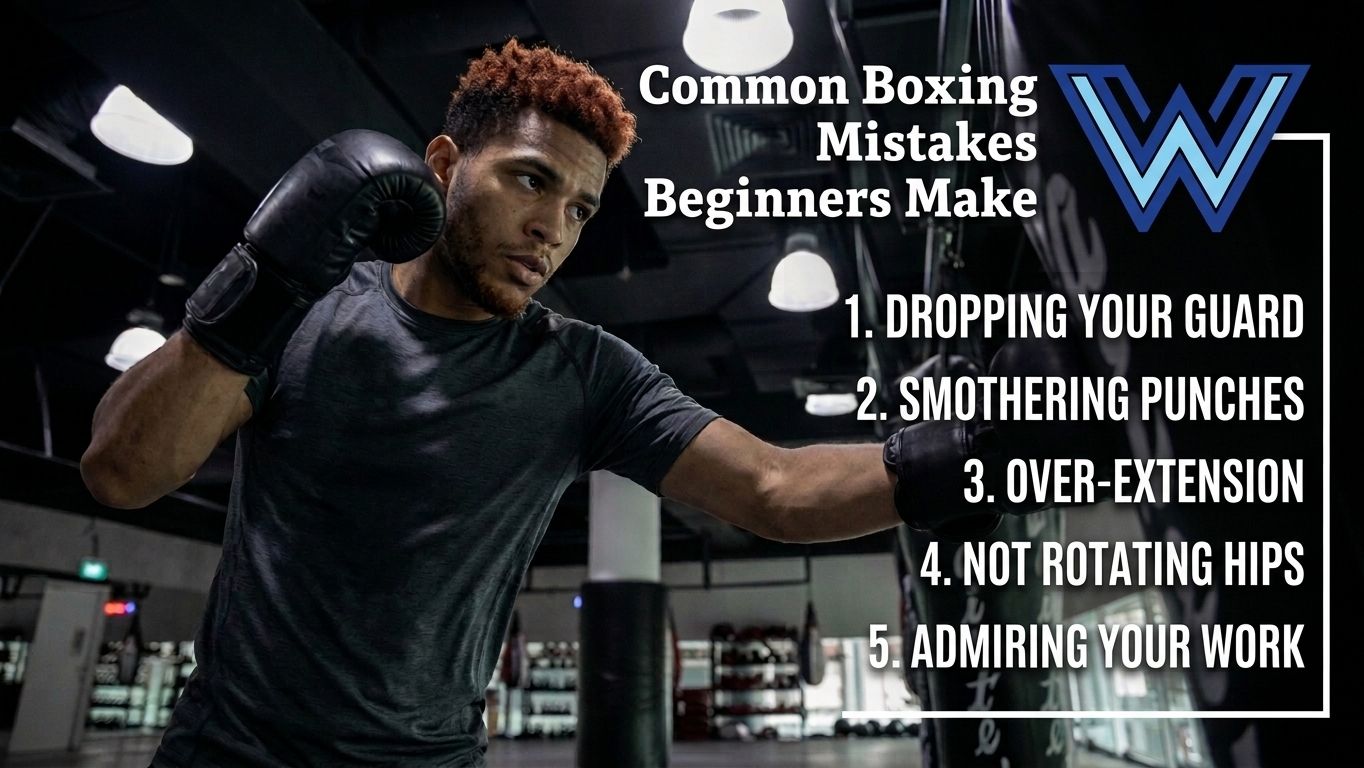
The most common boxing mistakes beginners make are dropping the guard while punching, failing to pivot the rear foot, holding their breath, leaning forward off balance, and rushing combinations before the technique is clean. Almost every one of these is invisible to the person doing it — which is exactly why they persist for months without a coach.
Our coaches at Witherspoon Boxing + Fitness, the boxing gym Bristol PA has trusted for two generations, correct these same nine faults every single week. Here is each one and how to fix it.
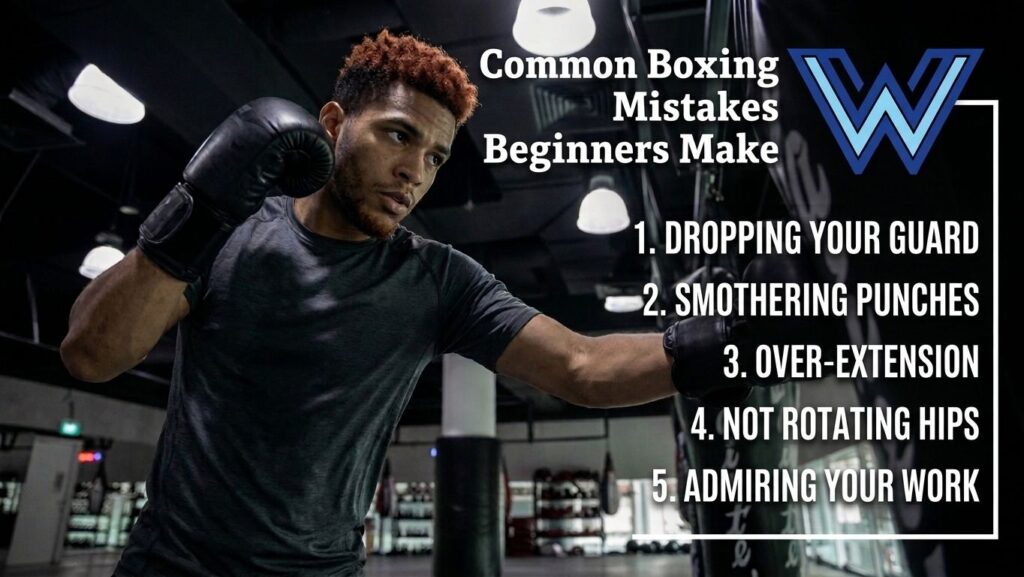
The 9 Mistakes at a Glance
| # | Mistake | What It Costs You |
|---|
| 1 | Dropping the guard | Exposed chin every time you punch |
| 2 | No rear foot pivot | Punches with no power behind them |
| 3 | Holding your breath | Gassing out in round two |
| 4 | Leaning forward | Lost balance, telegraphed punches |
| 5 | Rushing combinations | Speed built on bad technique |
| 6 | Standing flat-footed | Slow, predictable, easy to time |
| 7 | Bent wrist on impact | Genuine injury risk |
| 8 | Watching the hands | Late reactions, missed counters |
| 9 | Skipping fundamentals | An early plateau you cannot break |
1. Dropping the Guard While Punching
What happens: Your non-punching hand drifts down as the other hand goes out. You will swear it does not. It does.
The fix: Shadow box slowly in front of a mirror, watching only your non-punching hand. On the pads, have a coach tap your exposed side every time it drops — the feedback registers far faster than being told. Our guide on boxing stance and guard covers correct hand position in full.
What happens: You throw a cross or hook with your arm alone while your back foot stays planted. The punch feels weak because it is.
The fix: Turn your rear heel outward as if crushing something under the ball of your foot. Practice twenty slow crosses focusing only on the foot. Power comes from the floor up, never from the shoulder. See our breakdown on how to throw a hook in boxing for the full rotation chain.
3. Holding Your Breath
What happens: You tense up and stop breathing through combinations, then wonder why you are exhausted 90 seconds into round one.
The fix: Exhale sharply on every punch, not just the first. Many boxers make an audible sound with each shot — it is not showmanship, it forces the exhale. Count your breaths out loud during shadow boxing until it becomes automatic.
4. Leaning Forward
What happens: You reach for the target instead of stepping to it, putting your weight over your lead foot. You stumble after punching and telegraph everything.
The fix: Keep your weight balanced roughly evenly between both feet. If you cannot reach the bag, step in with your feet rather than lunging with your torso.
5. Rushing Combinations
What happens: You throw fast, sloppy punches that blur together. On the heavy bag it sounds like one long mushy thud instead of distinct impacts.
The fix: Halve your speed. Listen for four separate sounds in a four-punch combination. Speed is a product of clean technique, never a substitute for it. Our guide on boxing combinations for beginners covers the correct progression.
What happens: Your feet plant like concrete between punches. You become stationary, predictable, and easy to time.
The fix: Stay light on the balls of your feet with your rear heel slightly raised. Practice moving for a full round without throwing a single punch — three rounds of footwork alone will tell your legs everything they need to know.
7. Bent Wrist on Impact
What happens: Your wrist folds slightly as the punch lands. This is the fastest route to a hand or wrist injury.
The fix: Wrap your hands properly every session and keep the wrist locked straight through contact. Hand and wrist injuries are among the most common in striking sports, and the American Academy of Orthopaedic Surgeons highlights joint alignment as central to preventing them. If your knuckles or wrist ache after normal bag work, stop and speak to a coach.
8. Watching the Hands Instead of the Chest
What happens: You track your opponent’s gloves with your eyes, which means you are always reacting late.
The fix: Look at the centre of their chest. Your peripheral vision picks up both hands and both feet at once. This single change transforms reaction time, as our guide on counter punching for beginners explains.
9. Skipping Fundamentals to Chase Flashy Techniques
What happens: You want to throw uppercuts and slip like a professional before your jab is reliable. Progress stalls at around month four and never recovers.
The fix: Master the jab, then the cross, then footwork, then everything else. Fighters with two generations of professional experience behind them still drill the jab. There is a reason for that.
Why You Cannot Fix These Alone
Here is the uncomfortable truth about all nine. Your body feels correct even when it is not. Your guard drops for a fraction of a second and you will never know. Your rear heel stays planted and your brain reports that you pivoted.
That gap between what you feel and what actually happens is the single strongest argument for coached training. A coach standing two feet away catches every one of these within the first ten minutes — which is why anyone searching learn boxing near me makes far faster progress at a real boxing fitness center than punching a bag alone at home.

How Quickly These Get Fixed
| Mistake | Typical Time to Correct |
|---|
| Breathing | 1–2 sessions once you are aware of it |
| Wrist alignment | 1–2 sessions with proper wrapping |
| Rear foot pivot | 2–4 weeks of deliberate practice |
| Leaning forward | 2–4 weeks |
| Flat feet | 4–6 weeks |
| Dropping the guard | 4–8 weeks — the most stubborn of all |
| Watching the hands | 4–8 weeks |
| Rushing | Ongoing discipline |
Two to three sessions a week is what makes these timelines realistic. Train once a week and roughly double them.
Three Mistakes Outside the Technique
- Skipping the warm-up. Ten minutes of skipping and mobility protects your joints more than anything else you do.
- Training through joint pain. Muscle soreness is normal. Sharp joint pain is a signal to stop and tell a coach.
- Inconsistent attendance. Two sessions every week beats five in one keen week followed by nothing. Consistency is the entire game.
Two or three sessions weekly also meets the CDC’s recommendation of 150 minutes of moderate activity plus muscle-strengthening work on two or more days, which is part of why boxing and fitness work so well together.
Getting It Right From Week One in Bucks County
The easiest faults to fix are the ones that never form. Our boxing training for beginners program teaches fundamentals slowly and correctly from your very first session, with coaches circulating and correcting throughout.
The boxing classes Bucks County members rely on run seven days a week:
- Beginner Boxing — Mon/Wed 9:00 AM & 5:00 PM, Fri 9:00 AM, Sat 9:00 AM
- Advanced Boxing — Mon/Wed 6:00 PM, Sat 9:00 AM
- Adult Boxing — Tue/Thu 12:00 PM
- Women’s Boxing — Tue/Thu 7:00 PM, Sat 11:00 AM
- Kids Boxing (Ages 6–12) — Mon/Wed 7:00 PM, Tue/Thu 6:00 PM
- Cardio Boxing — Mon/Wed/Fri 6:00 AM, Tue/Thu 9:00 AM & 5:00 PM
- Sparring Lab — Mon/Wed 7:00 PM, Sat 10:00 AM
- Recovery & Mobility — Sun 9:00 AM
Our youth boxing classes teach the same fundamentals with age-appropriate, non-contact drilling. See the full weekly schedule.
Our staff is led by Tim Witherspoon Jr., and the Witherspoon family has competed at the professional level since the 1970s. Read more on our about us page or see the gym in our gallery.
Frequently Asked Questions
What is the most common mistake beginner boxers make?
Dropping the non-punching hand while throwing. It is also the most stubborn fault to correct, typically taking four to eight weeks.
Why do my punches feel weak?
Almost always because your rear foot is not pivoting. Power comes from the ground up through your hips, not from your arm.
Why do I get tired so fast when boxing?
Usually breath-holding rather than poor fitness. Exhale sharply on every punch and your endurance improves immediately.
Can I fix these mistakes on my own?
Breathing and wrist alignment, yes. The rest are invisible to you and need someone watching to correct.
How long does it take to correct bad habits?
Two to eight weeks for most faults with consistent coached training. Habits built over years take longer.
Should I train slower to fix my technique?
Yes. Halving your speed is the fastest route to clean technique, and speed follows naturally afterward.
Do kids make the same mistakes?
Largely the same ones, though they tend to correct faster because they have fewer ingrained habits.
What if I already have bad habits?
They are fixable. It takes deliberate slow practice and a coach watching, but nobody is stuck with them.
Get Corrected From Day One
Every fault on this list is easier to prevent than to undo. Come try one free class, and a coach will tell you within ten minutes what your body is actually doing — which is usually not what you think.

Booking Is This Simple
| Step | What You Do |
|---|
| 1 | Click the red Apply Now button below |
| 2 | Fill in your name, email, and the class you like |
| 3 | We call you back and confirm your free first class |
That is it. Gloves provided. No experience needed. Just show up.
👊 APPLY NOW — BOOK YOUR FREE CLASS
Prefer to talk first? Call (215) 458-8773 or email info@witherspoonboxing.com.
You can also message us on our contact page, read our story on about us, check gym updates in news, or browse more guides on the blog.
Witherspoon Boxing + Fitness — 925 Canal Street, Door 19, Bristol, PA 19007 — Bringing Out Everyone’s Inner Champion.

 Free every week