By Tim Witherspoon Jr.
7 min read
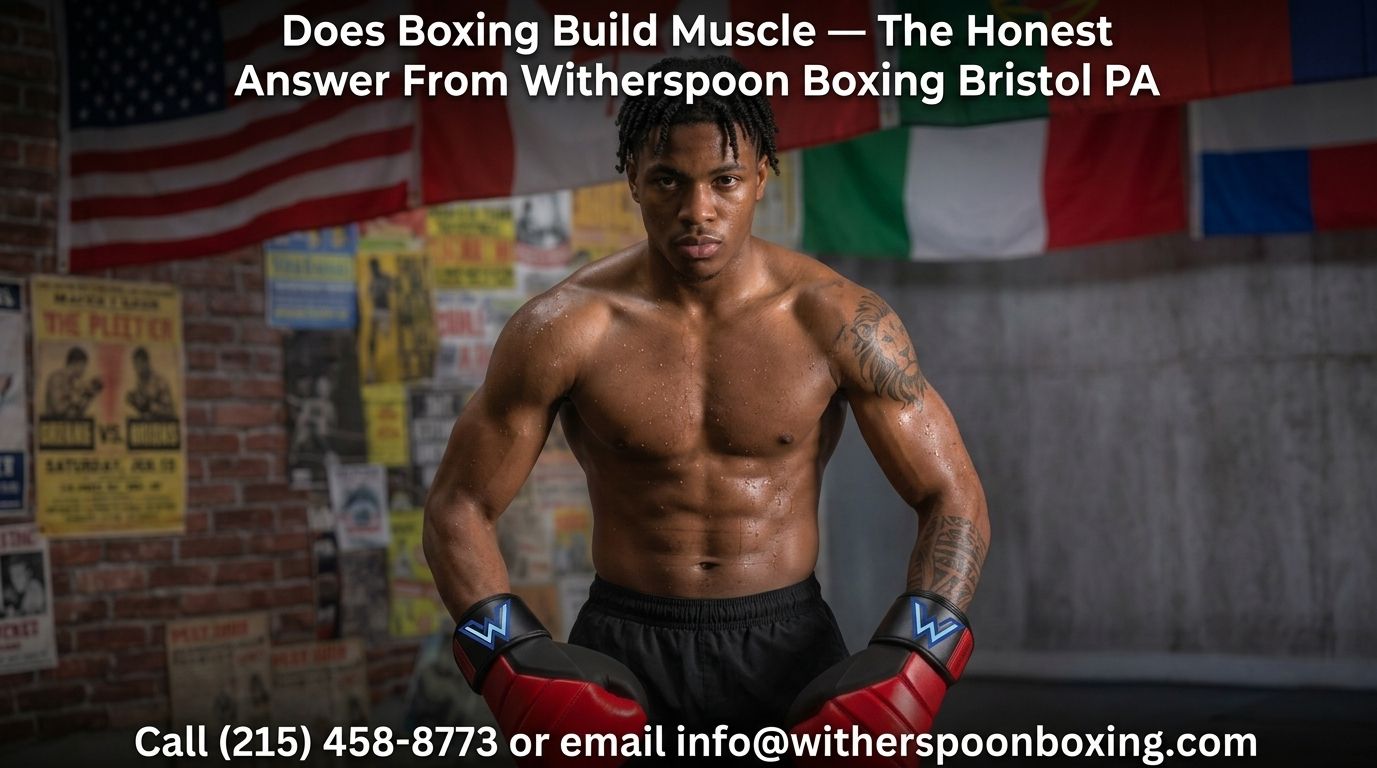
Does boxing build muscle? Boxing builds lean muscle, muscular endurance, and real functional strength — particularly through the shoulders, core, back, and legs. What it does not do efficiently on its own is add significant size. For visible muscle growth you need progressive resistance training alongside your boxing, which is why serious fighters lift.
Our coaches at Witherspoon Boxing + Fitness — the boxing gym Bristol PA has trusted for two generations — get this question constantly. Here is the honest version, without the marketing.
What Boxing Genuinely Builds
| Muscle Group | What Boxing Develops |
|---|
| Shoulders (deltoids) | Significant endurance from holding a guard and punching output |
| Core and obliques | Strong rotational development from every punch thrown |
| Upper back and lats | Engaged in both punch retraction and guard position |
| Legs and glutes | Constant work from stance, footwork, and rotation |
| Calves | Heavy use from time spent on the balls of the feet |
| Forearms and grip | Developed through impact absorption and clenching |
| Chest and triceps | Involved in punching, though not to a bodybuilding degree |
That is a genuinely full-body list. The distinction is what kind of development it produces.
Endurance vs Size — The Key Difference
Muscle adapts to what you ask of it. Boxing asks for high-repetition, low-resistance output sustained over minutes — which produces muscular endurance and density rather than bulk.
| Training Type | Primary Adaptation |
|---|
| Boxing rounds | Muscular endurance, conditioning, leanness |
| Heavy resistance training | Strength and size (hypertrophy) |
| Both combined | Strength, size, and endurance together |
Hypertrophy generally requires progressive overload — gradually increasing resistance over time. A heavy bag does not get heavier. Your body adapts to it within weeks and then has no reason to keep growing.
The National Strength and Conditioning Association documents how training variables such as load, volume, and progression determine which adaptation you get. Boxing sits firmly on the endurance side of that spectrum.
Why Boxers Look the Way They Do
Most boxers carry visible, defined muscle without being large. Three things produce that:
- Low body fat. High-output training strips fat, which makes existing muscle visible.
- Dense, functional muscle built for repeated output rather than maximal lifts.
- Supplementary strength work. Nearly every serious boxer lifts alongside their boxing.
Worth noting that definition and size are different things. Boxing is excellent at the first and limited at the second.
If You Want Size, Add This
Boxing plus resistance training is the combination that works. Our Strength & Strike class on Tuesday and Thursday at 6:00 AM is built exactly for this — boxing technique and genuine resistance work in one hour. Our guide on Strength and Strike covers what the session involves.
The movements that carry over best to boxing:
- Squats and deadlifts — legs and posterior chain, where punching power originates
- Rows and pull-ups — upper back, supporting guard endurance and punch retraction
- Overhead press — shoulder strength for holding a guard in later rounds
- Rotational core work — directly transfers into punch power
- Loaded carries — grip, core, and overall structural strength
The CDC’s physical activity guidance recommends adults include muscle-strengthening activity on two or more days a week alongside 150 minutes of moderate activity. Two boxing classes plus one strength session covers both comfortably.
Does Punching Build Arm Muscle?
Less than people assume. Punching power comes from the ground, through the legs and hips, and transfers out through a stable core — the arm mostly delivers what the body already generated. Our guide on how to throw a hook in boxing explains that chain in detail.
Your arms will become stronger and more defined from boxing. They will not get noticeably bigger from punching alone.
What About Core Development?
This is where boxing genuinely outperforms most training. Every punch is a rotation, every defensive movement engages the obliques, and maintaining stance is continuous isometric work.
Members routinely report core strength improvements they never achieved with dedicated ab work — because rotation under load is a more demanding stimulus than crunches.
Realistic Timeline
| Timeframe | What Changes |
|---|
| Weeks 1–4 | Shoulder and leg soreness, no visible change yet |
| Weeks 4–8 | Noticeably better endurance, early core strength gains |
| Weeks 8–12 | Visible definition, particularly shoulders and midsection |
| Months 3–6 | Clear body composition change with consistent training |
| With added strength work | Size gains alongside everything above |
This assumes two to three sessions a week. Our guide on how many times a week you should box covers frequency and recovery.
Nutrition Matters
You cannot build muscle in a significant calorie deficit, regardless of how you train. If size is your goal, that requires adequate protein and sufficient overall intake.
For personalised guidance, speak to a registered dietitian or your doctor — particularly if you are managing a health condition. Our guide on what to eat before a boxing workout covers training-day timing, which is a separate question from muscle gain.
Who Boxing Suits for Body Composition
| Your Goal | Is Boxing a Good Fit? |
|---|
| Lose fat, get lean | Excellent on its own |
| Build endurance and conditioning | Excellent on its own |
| Functional, athletic strength | Very good, better with strength work |
| Visible definition | Very good |
| Significant size gain | Needs dedicated resistance training |
| Core strength | Excellent — among the best options |
Training for Both in Bucks County
The boxing classes Bucks County members rely on cover both sides:
- Strength & Strike — Tue/Thu 6:00 AM
- Bootcamp — Tue/Thu 6:00 PM, Fri 10:00 AM
- Beginner Boxing — Mon/Wed 9:00 AM & 5:00 PM, Fri 9:00 AM, Sat 9:00 AM
- Advanced Boxing — Mon/Wed 6:00 PM, Sat 9:00 AM
- Adult Boxing — Tue/Thu 12:00 PM
- Women’s Boxing — Tue/Thu 7:00 PM, Sat 11:00 AM
- Cardio Boxing — Mon/Wed/Fri 6:00 AM, Tue/Thu 9:00 AM & 5:00 PM
- Kids Boxing (Ages 6–12) — Mon/Wed 7:00 PM, Tue/Thu 6:00 PM
- Sparring Lab — Mon/Wed 7:00 PM, Sat 10:00 AM
- Recovery & Mobility — Sun 9:00 AM
- Open Gym & Personal Training — daily, with a full strength room
See the full weekly schedule. Our youth boxing classes are entirely non-contact, and our boxing training for beginners program assumes no experience at all.
Coached by a Championship Family
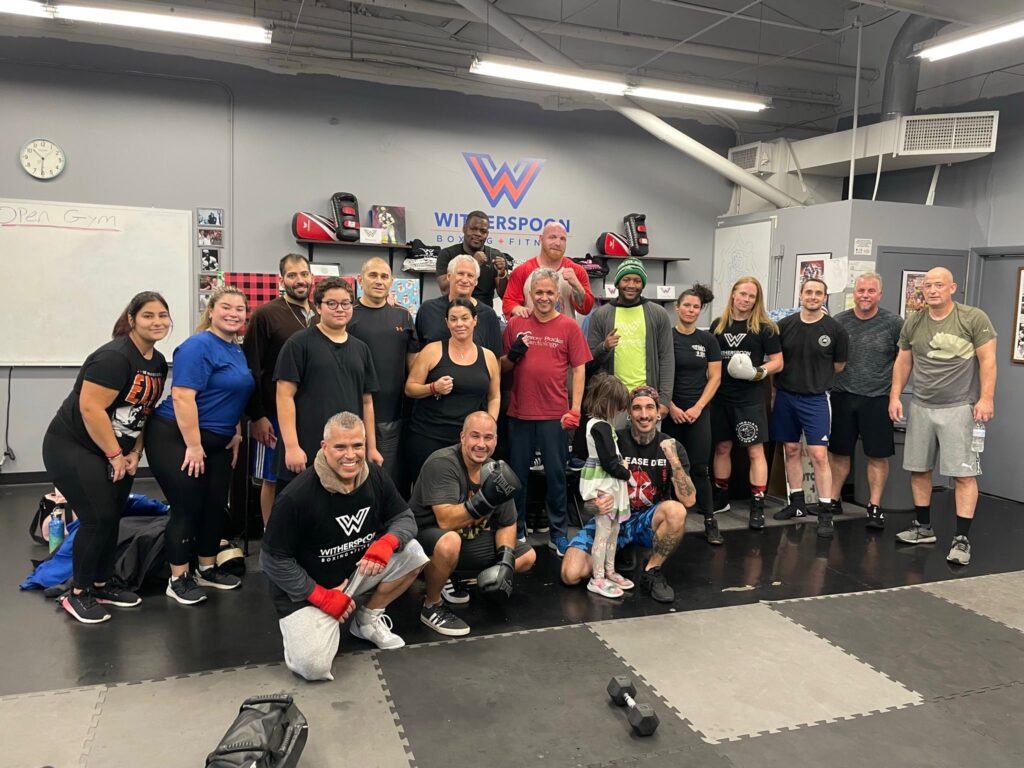
Our staff is led by Tim Witherspoon Jr., and the Witherspoon family has competed at the professional level since the 1970s. Strength work here is built around what actually improves boxing rather than what looks impressive.
Read more on our about us page or see the bag floor and strength room in our gallery. Anyone searching learn boxing near me in lower Bucks County will find a genuine boxing fitness center here, where boxing and fitness means both conditioning and real strength work under one roof.
Frequently Asked Questions
Does boxing build muscle?
It builds lean muscle, endurance, and functional strength, particularly in the shoulders, core, back, and legs. Significant size requires added resistance training.
Will boxing make my arms bigger?
Stronger and more defined, yes. Noticeably bigger, no — punching power comes from the legs and core rather than the arms.
Is boxing better than lifting weights?
Different goals entirely. Boxing wins for conditioning and fat loss; lifting wins for size and maximal strength. Combined, they work best.
Does boxing build abs?
Boxing develops the core exceptionally well through constant rotation. Visible abs also depend on body fat levels.
How long until I see muscle definition?
Most people notice visible change around eight to twelve weeks with two to three sessions a week.
Can I build muscle with boxing alone?
You will build endurance and some lean strength, but meaningful size gains need progressive resistance training.
Do I need to lift weights to box well?
Not to start, but strength work improves punch power, guard endurance, and injury resilience as you progress.
Is the first class free?
Yes. Gloves included, no membership required, no obligation to continue.
Come Find Out What It Does to You
Four weeks of two sessions a week will tell you more than any article. Come try one free class and feel which muscles you did not know you had.

Booking Is This Simple
| Step | What You Do |
|---|
| 1 | Click the red Apply Now button below |
| 2 | Fill in your name, email, and the class you like |
| 3 | We call you back and confirm your free first class |
That is it. Gloves provided. No experience needed. Just show up.
👊 APPLY NOW — BOOK YOUR FREE CLASS
Prefer to talk first? Call (215) 458-8773 or email info@witherspoonboxing.com.
You can also message us on our contact page, read our story on about us, check gym updates in news, or browse more guides on the blog.
Witherspoon Boxing + Fitness — 925 Canal Street, Door 19, Bristol, PA 19007 — Bringing Out Everyone’s Inner Champion.
 Free every week